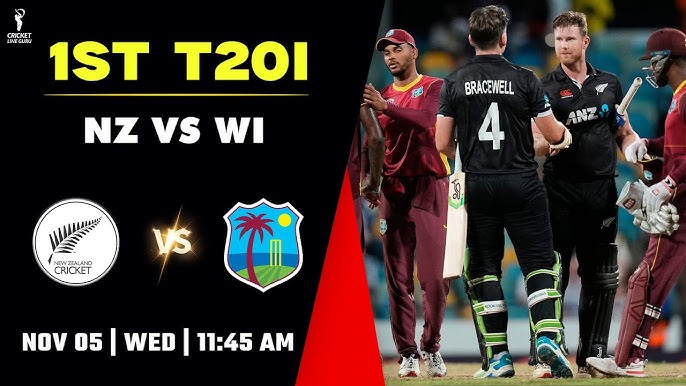
The Great Escape: How Sherfane Rutherford’s Scorecard Saved the West Indies (and Broke New Zealand’s Hearts)
It’s just a set of numbers, right? Runs, balls, wickets, economies. But sometimes, a cricket scorecard transcends mathematics and becomes a piece of pure, heart-pounding literature.
Last night’s clash between the West Indies and New Zealand was one of those times. It wasn’t a clean, clinical victory; it was a miraculous escape, a gut-wrenching near-miss, and the true story is buried in the stark, beautiful final column: WI 149/9 | NZ 136/9. West Indies won by 13 runs.
The Black Cap Attack: A Wicket-Taking Masterclass
Let’s be honest, the West Indies start read like a horror film for the home crowd.
- WI 22/4: Brandon King, Pooran, Chase, and Powell—the core of the batting lineup—gone in a flash. The New Zealand bowlers, especially Trent Boult (3/16) and Tim Southee (2/21), were relentless. Every dot ball was a dagger, every wicket a celebration that felt like the end of the game.
- The Sinking Feeling (WI 76/7): When Andre Russell was dismissed, the total was barely three figures. Cricket punditry was already writing the epitaph: “West Indies bundled out cheaply at home.” The Black Caps were brilliant, executing their plans perfectly on a tricky surface. The scorecard here was saying: Game Over.
The Turning Point: A Hero Rises from the Rubble
Enter Sherfane Rutherford. His final figures read: 68 runs off 39 balls. (2 Fours, 6 Sixes).*
Look closely at that asterisk. It means not out. It means he carried the entire weight of a fallen empire on his shoulders. From 76/7, he didn’t just stabilise; he counter-attacked. His last two overs were a blitzkrieg of boundaries, proving the age-old West Indies mantra: never give up on the power-hitter. He took the score from a humiliating 100-ish to a respectable, defensible 149.
- The Human Element: Imagine the pressure. The crowd is roaring, your team is collapsing, and the world’s best bowlers are hunting you. Rutherford didn’t just score runs; he bought his bowlers a chance to fight.
New Zealand’s Falter: The Weight of the Chase
The Kiwis had the momentum, but the chase was never easy. Glenn Phillips fought valiantly with a top-score of 40 (33), but the middle-order wobbled under the tight spin of Gudakesh Motie (3/25) and the pace of Alzarri Joseph (4/19).
- The Real Killer: Economy Rates. Look at Joseph’s 4.75 and Motie’s 6.25. On that pitch, those tight spells strangled the life out of New Zealand’s chase, forcing desperation and wickets. The Black Caps never got a comfortable partnership going, eventually falling short by just 13 runs.
This scorecard isn’t a history lesson; it’s a thriller movie. It’s the story of a dramatic collapse, a heroic, solo rescue mission, and a tight bowling performance that sealed the deal. It’s a testament to the magic of the West Indies: from the brink of disaster, they found a way.
West Indies vs. New Zealand: A Tale of Two Cricket Philosophies (Why Their Scorecards Always Intrigue)
Some rivalries are about geography (Australia vs. England). Others are about politics. But the cricketing encounters between the West Indies and New Zealand are a fascinating study in contrasting styles—a perfect evergreen topic that remains relevant regardless of the current match result.
At the heart of this rivalry is the clash between Caribbean Flair and Kiwis Grit. Analyzing their head-to-head scorecards over the decades reveals key patterns that define the two cricketing nations.
1. The Fluctuation of the West Indies Scorecard
The West Indies innings often look like a rollercoaster on a scorecard.
- The Highs: When they are good, they are electric. Expect massive sixes (reflecting the “Power-Hitting” style) and high strike rates from batters like Chris Gayle, Kieron Pollard, or more recently, Rovman Powell. Their highest scores are often built on sheer, brutal acceleration.
- The Lows: The flip side is volatility. Scorecards frequently show collapses (e.g., 5 wickets falling for under 30 runs). This is the inevitable risk of their aggressive, attacking philosophy. Their bowling, historically dominated by fearsome fast bowlers (The Four Horsemen), then relies on raw pace and intimidation.
- Evergreen Takeaway: The West Indies scorecard is rarely boring. It’s a metric for risk vs. reward.
2. The Consistency of the New Zealand Scorecard
New Zealand’s approach is defined by stability, smart strategy, and relentless consistency—traits often associated with successful teams on flat tracks and challenging conditions.
- Batting: Their strength lies in methodical accumulation. Batters often anchor the innings (Kane Williamson is the modern epitome), with partnerships being built on running between the wickets and clever shot selection rather than brute force. Their strike rates may be slightly lower, but their averages hold up.
- Bowling: New Zealand’s bowlers—from Trent Boult and Tim Southee to spinners like Daniel Vettori—excel in economy and line/length. They might not take 5 wickets in a spell often, but they choke the opposition’s scoring rate.
- Evergreen Takeaway: The New Zealand scorecard is a metric for discipline vs. flash. They aim to control the game, while the West Indies aim to destroy it.
| Scorecard Metric | West Indies Tendency (Flair) | New Zealand Tendency (Grit) |
| Top Order Batting | High Strike Rate, High Risk of Collapse | Lower Strike Rate, Higher Averages |
| Middle/Lower Order | Crucial Power-Hitting (Game-changing cameos) | Strategic Partnerships (Grinding out total) |
| Pace Bowling | Raw Speed, Bounce, and Wicket-taking focus | Swing, Seam, and Tight Economy Rate |
| Overall Result | High variance—can win big or lose big. | Lower variance—consistently competitive. |
The Thrill of the Encounter
The beauty of a WI vs. NZ scorecard is that it pits these two philosophies directly against each other. Can the West Indies’ chaotic brilliance overpower New Zealand’s methodical discipline?
Every single match, regardless of the format, is a referendum on these two deeply ingrained cricketing cultures. That is why, from a T20 World Cup thriller to a slow Test match grind, the final scoreboard between the Black Caps and the Windies remains one of cricket’s most intriguing reads.