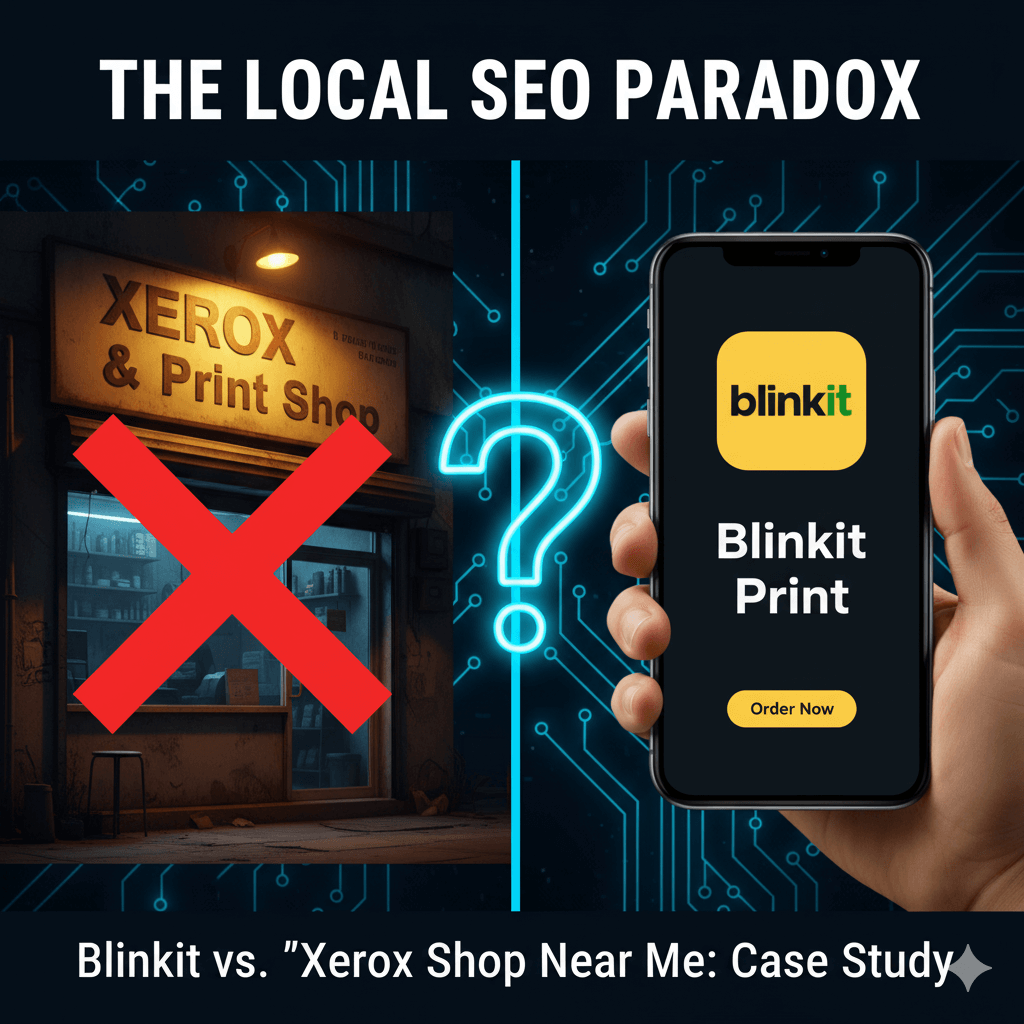
🤯 The Local SEO Paradox: How Blinkit Became the Top-Ranker for “Nearby Xerox Shop” (A Must-Read Case Study)
The search result was bizarre: a user searches for a hyper-local service like “nearby xerox shop” or “laminating shop near me,” and amidst the local listings, Google prominently displays… Blinkit (formerly Grofers).
How did a national quick-commerce giant, known for groceries and instant delivery, manage to outrank genuine, geo-tagged, mom-and-pop print shops? This isn’t a glitch; it’s a strategic SEO masterclass that highlights a massive shift in how large platforms leverage their digital authority.
1. The Anomaly: What We Are Seeing
The traditional rules of Local SEO (Search Engine Optimization) dictate that a small business needs:
- A verified Google Business Profile (GBP).
- A physical street address in the location the user is searching from.
- Local citations and reviews.
Blinkit, an aggregator, technically fails two of these for “xerox shop,” yet it dominates the search results. Why? Because Blinkit introduced its Print service, and they used their existing digital might to make it impossible to ignore.
2. The Weapon: Domain Authority & Crawl Budget
This entire strategy is built upon Blinkit’s core asset: Massive Domain Authority (DA).
- Trust Factor: Blinkit (or any large platform like Swiggy, Zomato, etc.) has built immense trust and authority with Google over years of operation. Google assumes anything Blinkit publishes is relevant and high-quality.
- Crawl Power: Blinkit’s website is massive and frequently crawled. When they launched the “Print” service, Google indexed that new section almost instantly, giving it immediate ranking power.
- The Power of the Subdomain/Section: They didn’t need to build a new website. They simply added a new section, like
blinkit.com/print, inheriting the full power of the parent domain.
3. The SEO Masterstroke: Location & Service Mapping
This is where the local SEO rule-bending begins. Blinkit couldn’t set up a Google Business Profile for thousands of phantom “xerox shops.” Instead, they used sophisticated content mapping:
A. The Intent-Based Landing Page Strategy
Blinkit created a series of landing pages that perfectly mirrored what a user was searching for:
- Targeted Content: Pages weren’t just about “Blinkit Print Service.” They were hyper-focused on the user’s intent, with titles like: “Online Document Printing and Photocopy Near You.”
- Keyword Variation: They targeted every variation: “nearby xerox shop,” “document print shop near me,” “colour printout service,” “laminating.”
B. The Pincode-Level Geolocation Mapping
This is the most critical element. Blinkit serves thousands of delivery zones (pincodes). Instead of relying on Google’s physical address validation, they leveraged their operational network:
- Pincode Pages: For every major city (e.g., Delhi, Mumbai, Bengaluru), they likely created or programmatically generated pages that reference nearby operational zones.
- Dynamic Copy: The page copy dynamically updates based on your IP address, displaying a message like: “Blinkit Print Service is available in [Your Current Locality/Pincode].” This signals to Google that they are a locally relevant service provider for that exact area.
4. The Local SEO Defiance (Or Redefinition)
Blinkit’s success in this space proves that for massive platforms, Operational Reach > Physical Storefront.
| Traditional Local SEO (Small Shop) | Platform SEO (Blinkit) |
| Needs Physical Address for validation. | Uses Pincode & Delivery Zones as the “address.” |
| Authority built via local reviews & citations. | Authority inherited from parent domain’s DA. |
| Ranks for “Shop Near Me.” | Ranks for “Service Near Me” because they deliver the service. |
They redefined the “shop near me” search intent from “where is the nearest building?” to “who is the nearest provider that can fulfill my request?” Since Blinkit can fulfill the request faster than most shops, Google rewards them.
5. Case Study Conclusion & Key Takeaways
The Blinkit “Xerox Shop” case study is a chilling lesson for small businesses and a blueprint for large platforms.
📝 Lessons for Small Businesses:
- Specialization is Key: Don’t try to compete with DA; focus on services Blinkit can’t do (e.g., specialized design prints, binding, bulk printing).
- Optimize GBP Uniquely: Ensure your Google Business Profile is meticulously optimized with services, unique photos, and recent posts. Blinkit can’t fully replicate the authenticity of your local presence.
📈 Lessons for Large Platforms:
- Launch New Services as Sub-Sections: Leverage existing domain authority for instant ranking power.
- Map Intent to Operations: Use your delivery network (pincodes, service zones) as a powerful, large-scale substitute for physical addresses in Local SEO.
The search for a “xerox shop near me” is no longer about geography; it’s about fulfilment efficiency. And for now, giants like Blinkit, Zepto, Instamart are showing they have the digital authority to win that game.